Information and Communication Technology (ICT): Its Positive and Negative Impacts

What is ICT?

Information and communications technology (ICT) is an extensional term for information technology (IT) that stresses the role of unified communications and the integration of telecommunications (telephone lines and wireless signals) and computers as per IFGICT, as well as necessary enterprise software, middleware, storage and audiovisual, that enable users to access, store, transmit, understand and manipulate information as per the international federation of ICT.

The term ICT is also used to refer to the convergence of audiovisual and telephone networks with computer networks through a single cabling or link system. There are large economic incentives to merge the telephone network with the computer network system using a single unified system of cabling, signal distribution, and management. ICT is an umbrella term that includes any communication device, encompassing radio, television, cell phones, computer and network hardware, satellite systems and so on, as well as the various services and appliances with them such as video conferencing and distance learning.

ICT is a broad subject and the concepts are evolving. It covers any product that will store, retrieve, manipulate, transmit, or receive information electronically in a digital form (e.g., personal computers including smartphones, digital television, email, or robots). Theoretical differences between interpersonal-communication technologies and mass-communication technologies have been identified by the philosopher Piyush Mathur. Skills Framework for the Information Age is one of many models for describing and managing competencies for ICT professionals for the 21st century.
The Positive impacts of ICT

  • Access to information: Possibly the greatest effect of ICT on individuals is the huge increase in access to information and services that has accompanied the growth of the Internet. Some of the positive aspects of this increased access are better, and often cheaper, communications, such as VoIP phone and Instant Messaging. In addition, the use of ICT to access information has brought new opportunities for leisure and entertainment, the facility to make contacts and form relationships with people around the world, and the ability to obtain goods and services from a wider range of suppliers.
  • Improved access to education, e.g. distance learning and on-line tutorials. New ways of learning, e.g. interactive multi-media and virtual reality. New job opportunities, e.g. flexible and mobile working, virtual offices and jobs in the communications industry.
  • New tools, new opportunities: The second big effect of ICT is that it gives access to new tools that did not previously exist. A lot of these are tied into the access to information mentioned above, but there are many examples of stand-alone ICT systems as well
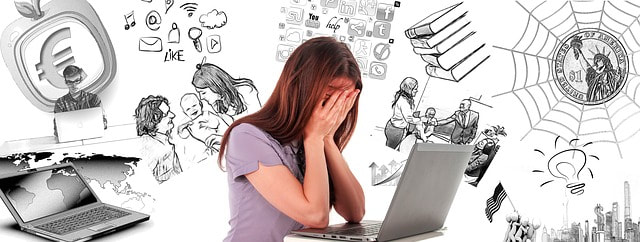
The Negative Impacts of ICT

  • Job loss: One of the largest negative effects of ICT can be the loss of a person’s job. This has both economic consequences, loss of income, and social consequences, loss of status and self esteem. Job losses may occur for several reasons, including: Manual operations being replaced by automation. e.g. robots replacing people on an assembly line.Job export. e.g. Data processing work being sent to other countries where operating costs are lower. Multiple workers being replaced by a smaller number who are able to do the same amount of work. e.g. A worker on a supermarket checkout can serve more customers per hour if a bar-code scanner linked to a computerized till is used to detect goods instead of the worker having to enter the item and price manually.
  • Reduced personal interaction: Being able to work from home is usually regarded as being a positive effect of using ICT, but there can be negative aspects as well. Most people need some form of social interaction in their daily lives and if they do not get the chance to meet and talk with other people they may feel isolated and unhappy.
  • Reduced physical activity: A third negative effect of ICT is that users may adopt a more sedentary lifestyle. This can lead to health problems such as obesity, heart disease, and diabetes. Many countries have workplace regulations to prevent problems such as repetitive strain injury or eyestrain, but lack of physical exercise is rarely addressed as a specific health hazard.
  • Depression and anxiety. Human beings need face-to-face contact to be mentally healthy. Nothing reduces stress and boosts your mood faster or more effectively than eye-to-eye contact with someone who cares about you. The more you prioritize social media interaction over in-person relationships, the more you’re at risk for developing or exacerbating mood disorders such as anxiety and depression.
  • Cyberbullying. About 10 percent of teens report being bullied on social media and many other users are subjected to offensive comments. Social media platforms such as Twitter can be hotspots for spreading hurtful rumors, lies, and abuse that can leave lasting emotional scars.
  • Self-absorption. Sharing endless selfies and all your innermost thoughts on social media can create an unhealthy self-centeredness and distance you from real-life connections.
  • Accessing Stored Communications or hacking; Intentionally accessing, without authorization, a facility through which an electronic communication service is provided. The act of obtaining unauthorized access to data from computer network. This is typically done to commercial and government sites to threaten its owner. In late 2015, a group of Anonymous Philippines hacked the Twitter account of actress Maine Mendoza, who plays the famous character Yaya Dub of the popular AlDub tandem and posted links and messages on the account.

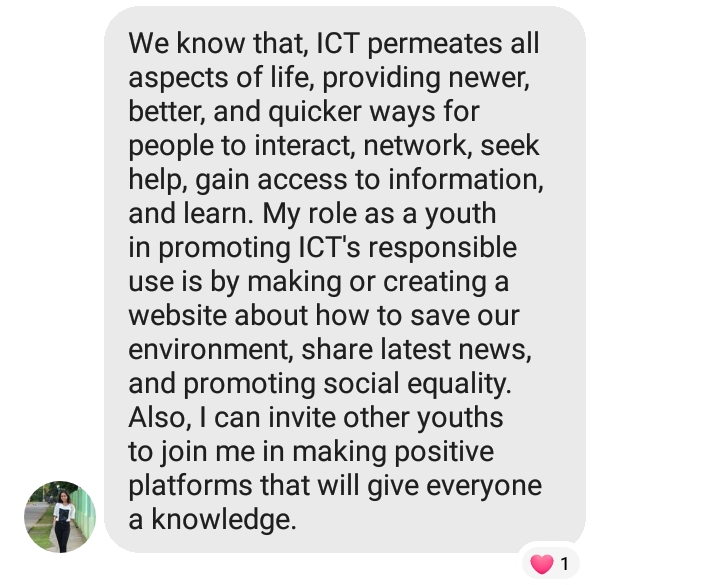
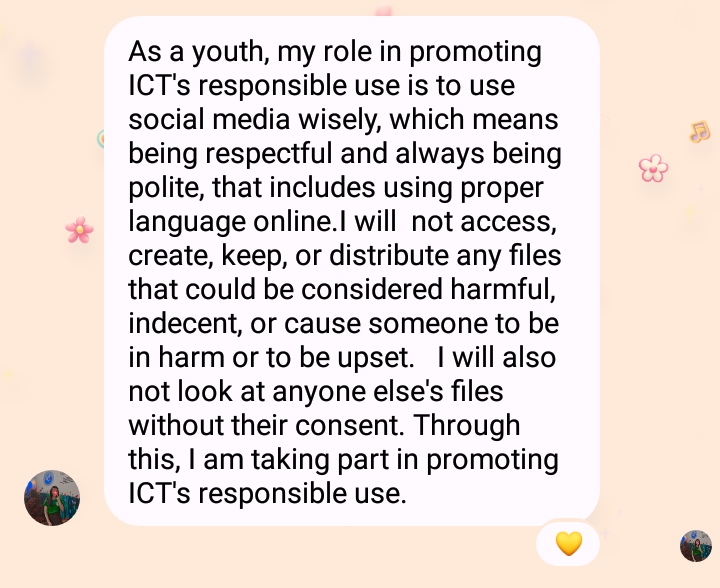
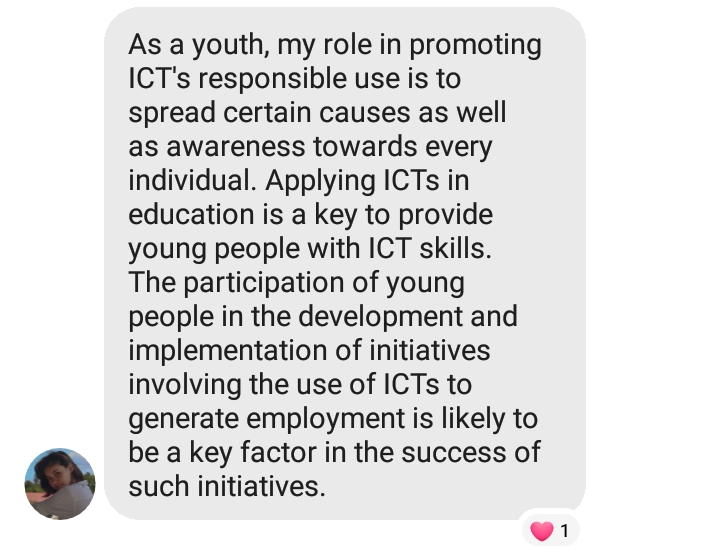
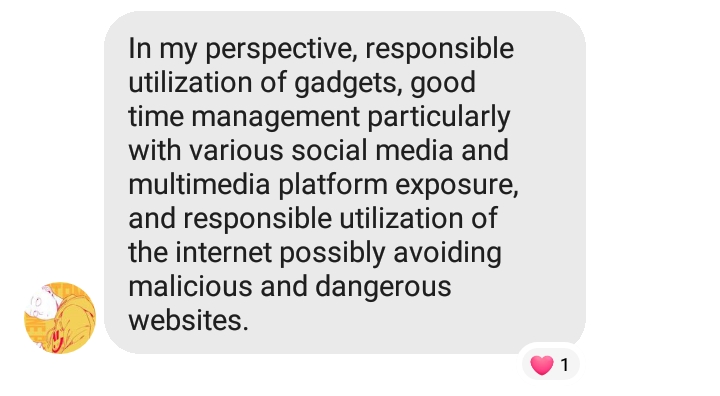
The Youth’s Role in Helping to Promote ICTs  Responsible Use

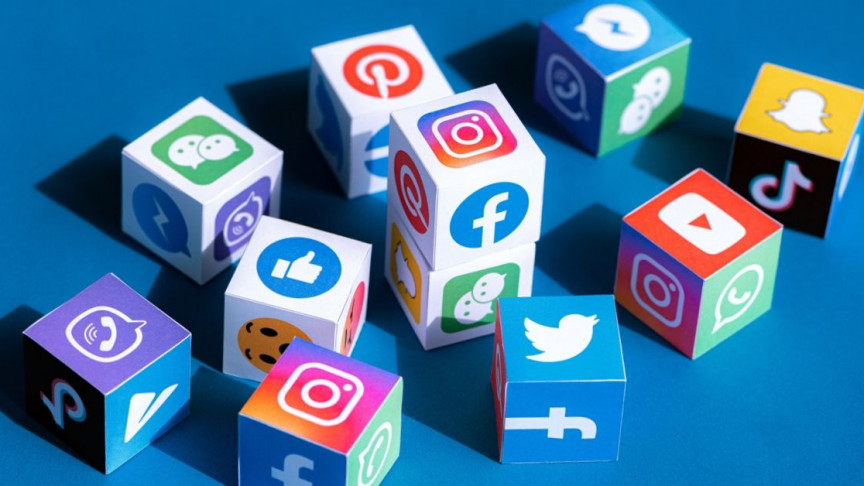
Over 70% of youth report use of social media such as Facebook, Instagram, Snapchat, Twitter, YouTube, Tumblr, and the list of possible platforms continues to expand. The majority of youth report using more than one social media platform. Social media use, and internet use more generally, is a typical part of most youths’ daily lives. Supporting them in responsible use and navigation of various platforms is important for any supportive adults in their lives.

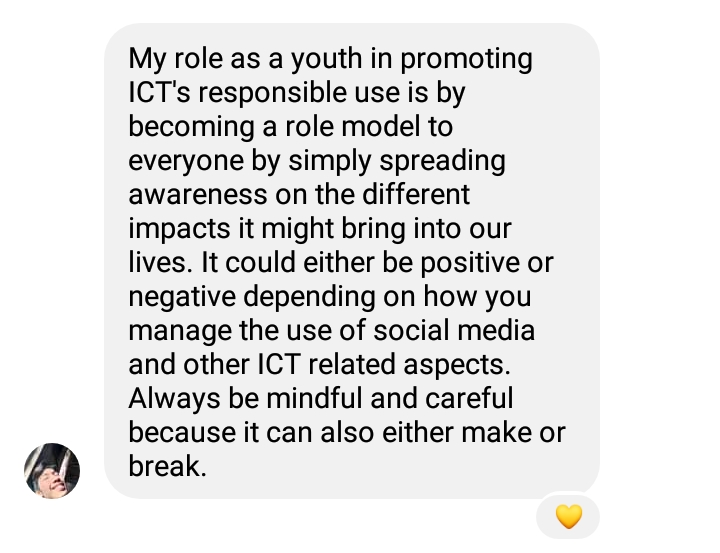
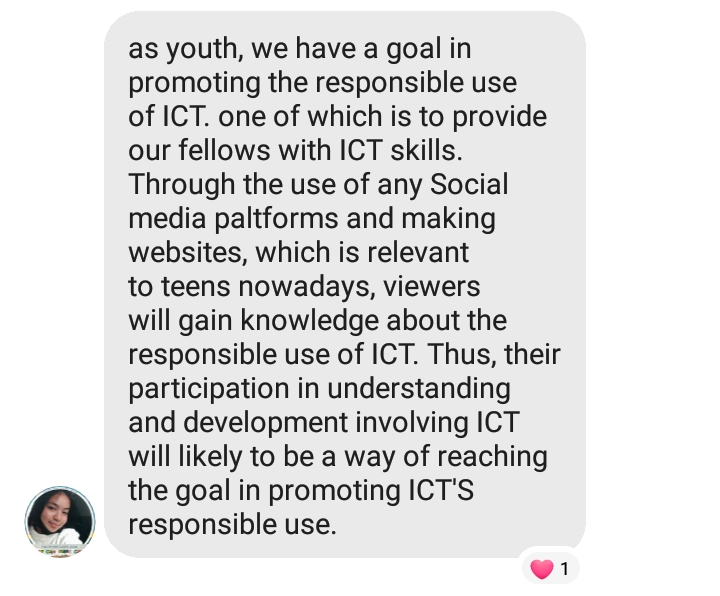
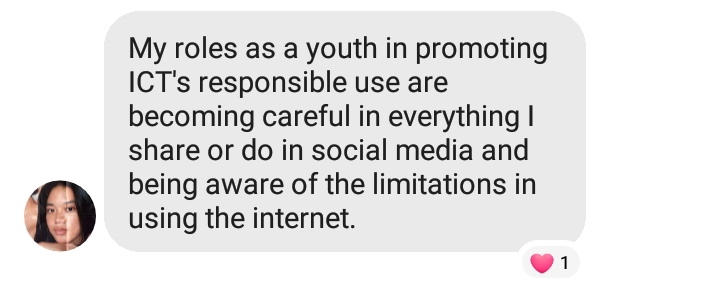
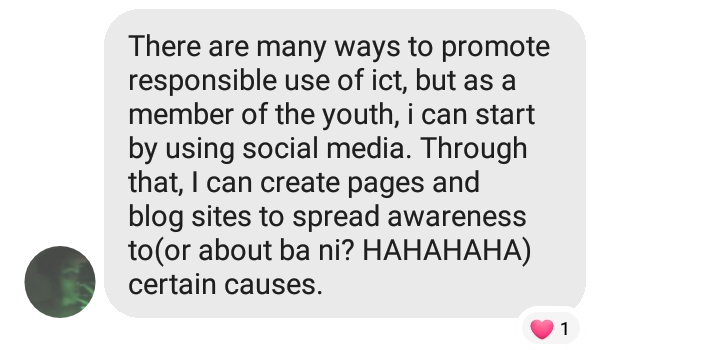
Here’s the response of my classmates as to what is/are their role(s) in helping to promote ICTs responsible use.

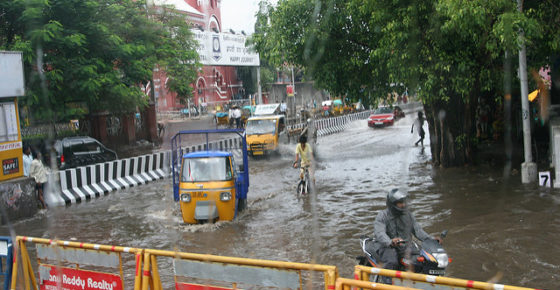
The Use of Social Media as a Platform During Calamities and Disasters

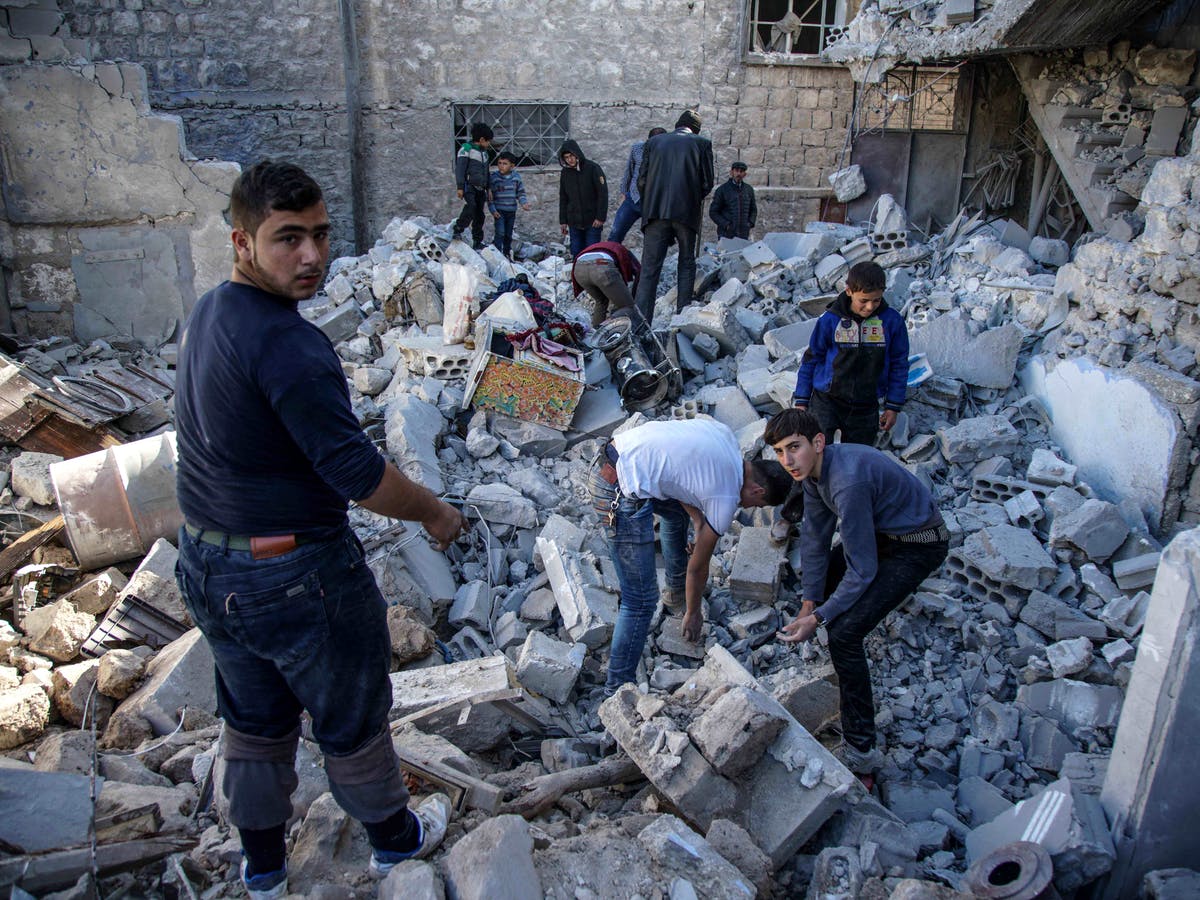
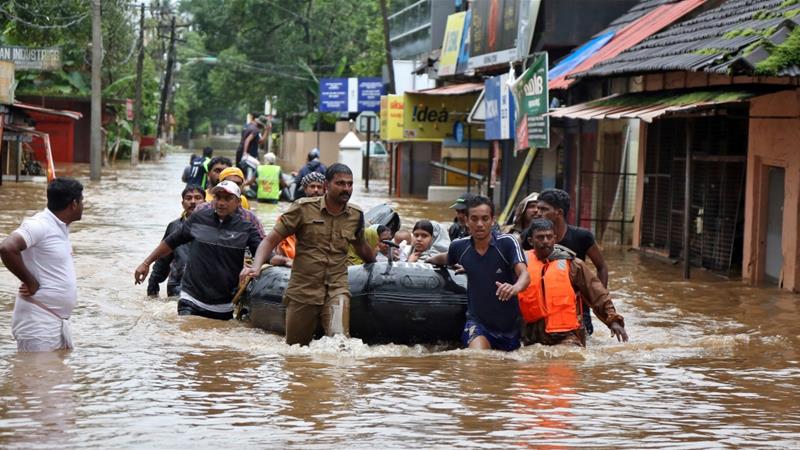
Social media are interactive technologies that allow the creation or sharing/exchange of information, ideas, career interests, and other forms of expression via virtual communities and networks. It helps so many people to interact with each other especially those who have loved ones who are working or living a life already in distance. On the other hand, social media is also considered a useful platform during disasters and calamities. Many have used this platform to ask for help and give help to those who are in need.

Since the mid-1990s, new technologies have emerged that allow people to interact and share information through the Internet. Often called “social media,” these platforms enable people to connect in ways that were non-existent, or widely unavailable 15 years ago. Examples of social media include blogs, chat rooms, discussion forums, wikis, YouTube channels, LinkedIn, Facebook, and Twitter. Social media can be accessed by computers, tablets, smart and cellular telephones, and mobile telephone text messaging (SMS).

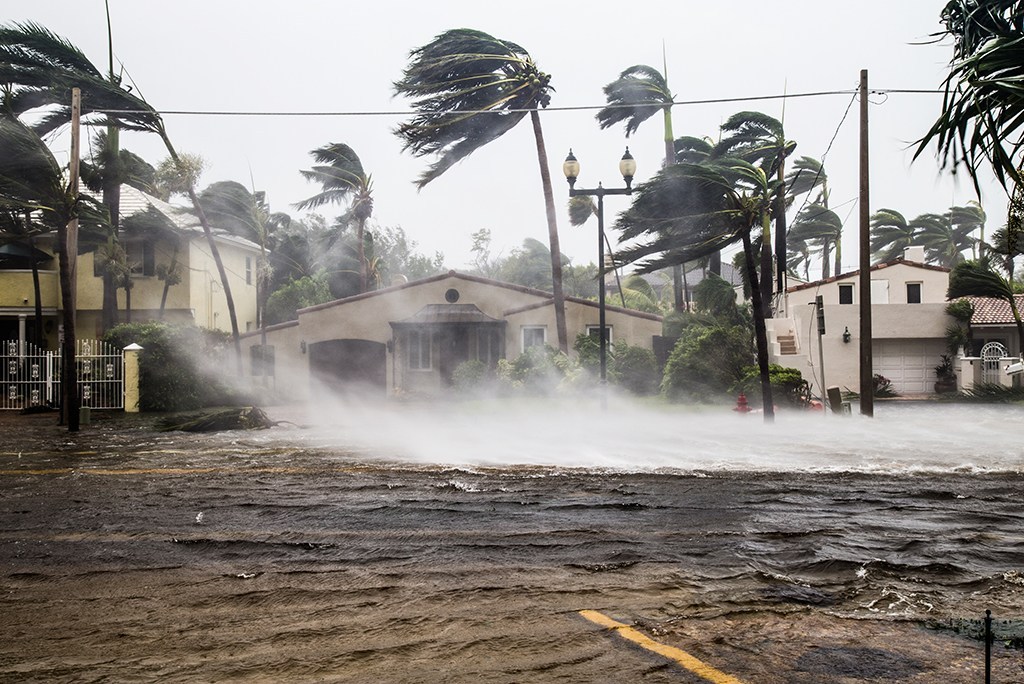
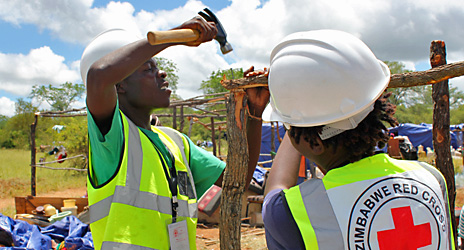
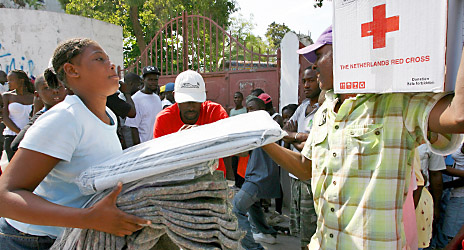
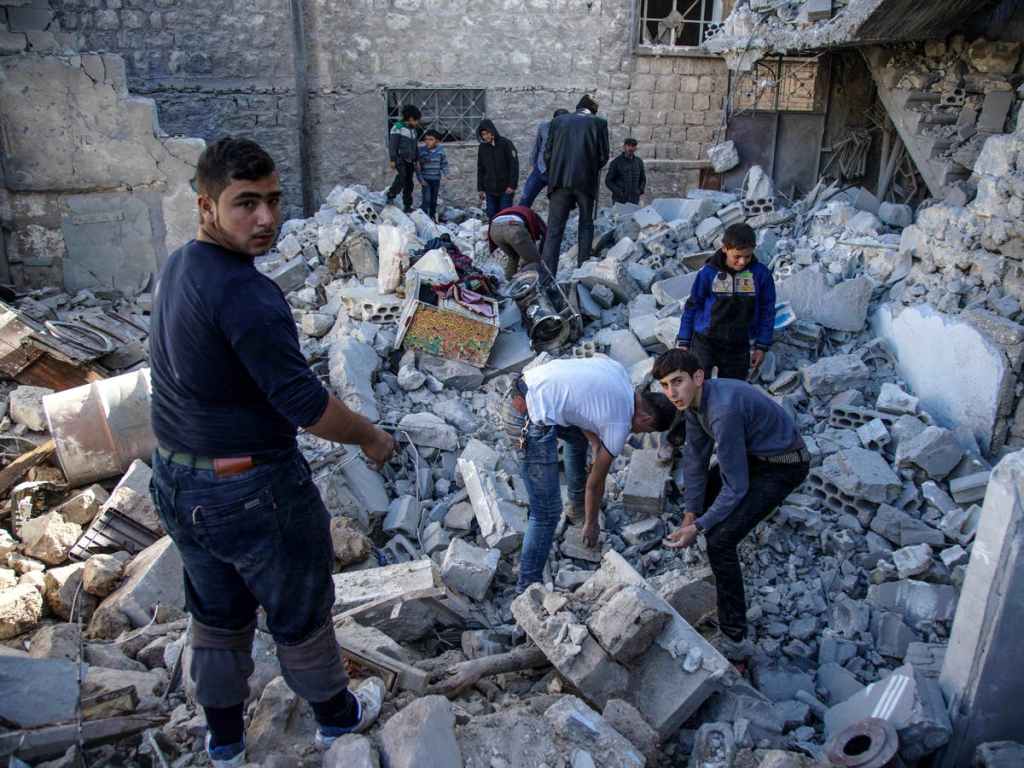
In recent years social media has played an increasing role in emergencies and disasters. Social media sites now rank as the fourth most popular source to access emergency information. They have been used by individuals and communities to warn others of unsafe areas or situations, inform friends and family that someone is safe, and raise funds for disaster relief. Facebook supports numerous emergency-related organizations, including Information Systems for Crisis Response and Management (ISCRAM), the Humanitarian Free and Open Source Software (FOSS) Project, as well as numerous universities with disaster-related academic programs.

Social media has been a great help to inform people around the world that something is happening already and there are people who needs them. The use of social media for emergencies and disasters may be conceptualized as two broad categories. First, social media can be used as an output to disseminate information and issue warnings. Second, it can be used as an emergency management tool through the systematic use of inputs. Examples of systematic usage of social media include using the medium to conduct emergency communications; using social media to receive victim requests for assistance; monitoring user activities to establish situational awareness; and using uploaded images to create damage estimates; conduct investigations; monitor search queries to anticipate flu outbreaks and detect terrorist activity; among others.

SOCIAL VS TRADITIONAL MEDIA

It’s 2016, and professionals are still claiming social media is “on the rise.” According to a recent PR Newswire release, the worldwide social media analytics market is set to grow from $1.6 billion in 2015 to $5.4 billion by 2020.

Among traditional PR agencies, where earned media is king, the juxtaposition between social and traditional media is still a constant battle. I believe that this sense of “either/or” is wrong and that we need to look at the two together, from both a measurement and programming perspective.

Here are a few of the reasons that there are immense differences between traditional and social media:

-Social media reaches a maximum audience, while traditional media’s audience is generally more targeted.
-Social media is versatile (you can make changes once published), whereas traditional media, once published, is set in stone.
-Social media is immediate, while traditional can be delayed due to press times.
-Social media is a two-way conversation, and traditional is one-way.
-Social media often has unreliable demographic data, but traditional media’s is more accurate.

Ten Uncommonly used Filipino Words

Many Filipinos laugh at foreigners because they are slurred in speech or because they are struggling to speak our language.But did you know that we Filipinos also don't really know all the words that are used by our ancestors. The new generation no longer knows the deep words used then.🤭

Have you ever heard the words yakis (menstrual) or duyog (eclipse)? If not come on and let's study it together!

Hello friends! In unison, we're going to learn some of Philippines most uncommon filipino words that you can also share with your family and friends.


2. Filipino word: Kansunsilyo

English translation: Boxer short

Definition: Boxer shorts (also known as loose boxers or as simply boxers) are a type of undergarment typically worn by men. The term has been used in English since 1944 for all-around-elastic shorts, so named after the shorts worn by boxers, for whom unhindered leg movement (“footwork”) is very important. (Source: Wikipedia)

Sentence Example: Ginamit ng aking nakababatang kapatid ang kansunsilyo ng aking ama.
3.Filipino word: Batlag

English translation: Car

Definition: A four-wheeled road vehicle that is powered by an engine and is able to carry a small number of people. (Source: Merriam-Webster)

Sentence example: Ang aming kapitbahay ay bumili ng bagong batlag kaninang umaga.
4. Filipino word: Sulatroniko

English translation: E-mail

Definition: Electronic mail is a method of exchanging messages between people using electronic devices. Email entered limited use in the 1960s, but users could only send to users of the same computer, and some early email systems required the author and the recipient to both be online simultaneously, similar to instant messaging. (Source: Wikipedia)

Sentence example: Ang aking kamag-aral ay nagpadala sa sulatroniko ng mensahe para sa kaniyang mga magulang sa probinsya.
5.Filipino word: Labaha

English translation: Razor

Definition: An instrument with a sharp blade or combination of blades, used to remove unwanted hair from the face or body. (Source: Merriam-Webster)

Sentence example: Ginamit ng aking tatay ang kaniyang labaha kanina pang-ahit sa kaniyang balbas.
6.Filipino word: Durungawan

English translation: Window

Definition: An opening in the wall or roof of a building or vehicle that is fitted with glass or other transparent material in a frame to admit light or air and allow people to see out.(Source: Merriam-Webster)

Sentence example: Maagang dumungaw si Aling Nena sa kaniyang durungawan.
7.Filipino word: Anluwage

English translation: Carpenter

Definition: A person who makes and repairs wooden objects and structures. (Source: https://www.dictionary.com/browse/carpenter)

Sentence example: Maagang nagtatrabaho ang mga anluwage sa amin.
8. Filipino word: Sambat

English translation: Fork

Definition: An implement with two or more prongs used for lifting food to the mouth or holding it when cutting. (Source: Definitions from Oxford Languages)

Sentence example: Minsan lamang kumain gamit ang sambat ang mga tao sa isang nayon na malapit sa bundok.
9. Filipino word: Pulot-gata

English translation: Honeymoon

Definition: A vacation spent together by a newly married couple. (Source: Definitions from Oxford Languages)

Sentence example: Pagkatapos nilang ikasal kahapon ay pumunta na silang Maldives para sa kanilang pulot-gata.
Filipino word: Dupil

English translation: Amulet

Definition: An ornament or small piece of jewelry thought to give protection against evil, danger, or disease. (Source: Definitions from Oxford Languages)

Sentence example: Ginamit ni Don Juan noon ang kaniyang dupil na minana pa niya sa kaniyang mga magulang

Basically, that is not the only uncommon words of our language. We should always look back to those years that our ancestors uses such words by reading or scrolling the internet because that is the trend nowadays. Let us love and cherish the words left to us by our ancestors so that we can hear and be proud of it for future generations.💗

Design a site like this with WordPress.com
Get started